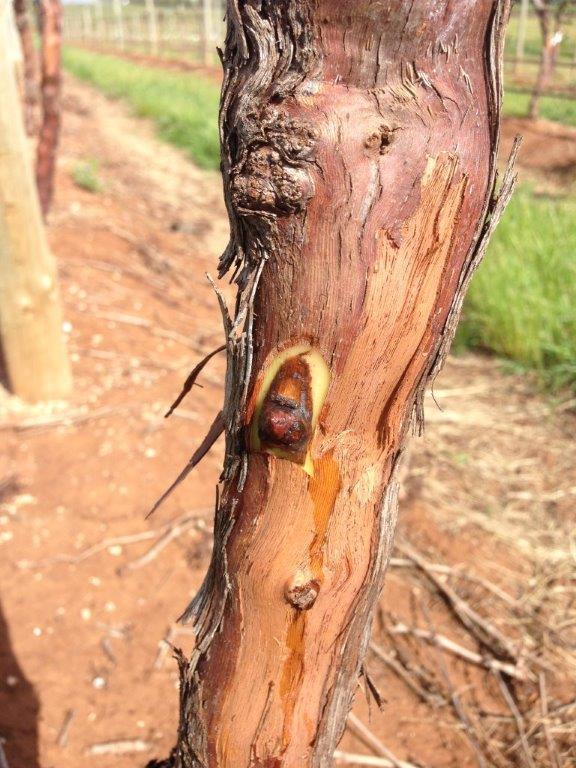
Section 1: Introduction to Field Grafting

“Field grafting is a great way to change variety or clone and quickly return a vineyard to full productive potential. Field grafters are only partly responsible for the success or failure of field grafting. Understanding what preparation and followup is required as a grower to influence the final strike rate is critical. VitiSense provides all the information, techniques, demonstrations and explanations and to ensure your field grafting experience is a positive one”.
Introduction to grafting
Grafting is the process of joining two separate plants together to combine the benefits of a root system and fruiting part of the plant into one. The rootsystem (rootstock) is the lower section and the fruiting part (scion) is grafted above. Grapevine grafting can be performed in the nursery on new vines for planting or in the vineyard on established vines. Most vineyards are well suited to field grafting with the only limiting factors being virus, trunk disease. Field grafting allows the grower to keep pace with changing consumer trends for wine varieties and table grapes without the long lead times for replanting.
Furphy: “Field grafted vines “fall over” or die after a few seasons”
False. I have not seen this happen and there is no reason for this to occur through grafting. Other factors such as virus and trunk disease or mis-management are likely to be the reasons for a failed vineyard.
Reasons for grafting
Grafting can be used to;
- change variety,
- change clone,
- correct bent trunks,
- replace diseased or non performing cordons,
- Increase strike rate in reworking vineyards,
- Regenrerate vines after trunk disease removal,
- Retrofit rootstocks to established own-rooted vines
Field grafting versus replanting
Field Grafting has many benefits over replanting;
- Utilise valuable existing vineyard infrastructure – trellis, irrigation, vine trunks.
- Rapid establishment of fruiting canes and filling cordon wire.
- Faster return to full yield production – 1 year grafting compared with 3-5 years replanting.
- Elevated training for cordons from top-working existing tall trunks results in faster cordon establishment (closer to the wire), avoids the added expense of using vine guards and more difficult weed management associated with new plantings and less bending for staff/contractors (OHS considerations).
- Less pressure on irrigation and nutrition with established trunks and rootsytems on grafting rootstocks.
- Less pest and disease pressure especially from chewing pests with field grafted vines and they are easier to apply sprays at cordon height compared with newly panted vines.
- Less vulnerability of grafts to extreme heat compared with new plantings.
- In most cases, grafted vines can be machine harvested in the first year after grafting which is a considerable cost saving when compared with hand harvesting newly planted vines.
- Vine balance is achieved faster and at higher yield with field grafted vines.
Types of grafting
- Grapevines can be grafted through a number of techniques.
- Nursery (omega)
- Nursery (chip bud)
- Usually restricted to nursery grafting to join dormant scion and rootstocks prior to planting in a field nursery.
- Bench operated machines
- Field grafting chip
- Field grafting T bud
- Field grafting Cleft
Grafting contractors/grafters
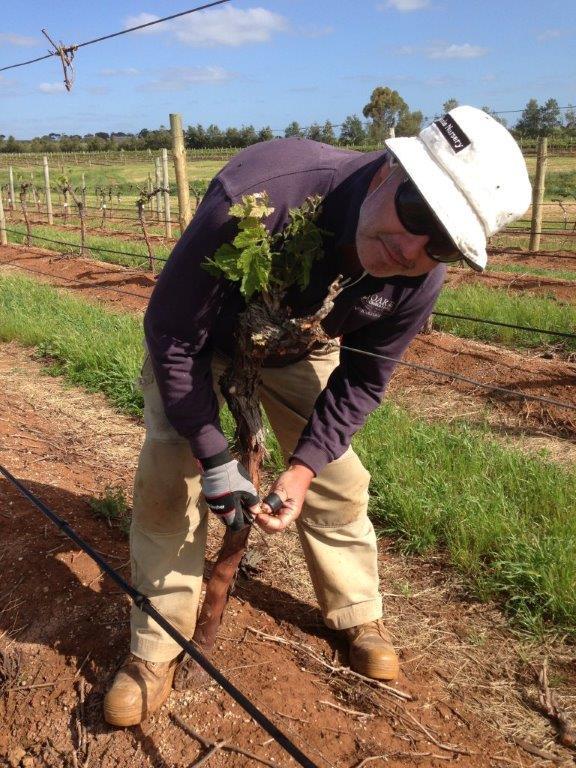
Grafters are highly skilled and specialised in their field. There are only a handful of professional grafters Worldwide and their skills cannot be passed on easilly without time spent practicing over many seasons in the vineyard. Field grafters are only considered a professional after 5 seasons experience. Grafting is a skill that involves placing buds into a trunk or joining the scion to the rootstock. This can be learnt in a short tutorial however, commercial field grafters have many years of experience to allow for the many variables in vineyards which can influence the success of a grafting exercise. Most grafters begin as tapers or budcutting support staff for grafters and are able to learn on the job. Grafting is a physically and mentally demanding job which long hours bent over vines making precision cuts into hard wood and dealing with weather ranging from extreme heat, rain, wind and even snow. The grafting season is short usually over a 4 month period commencing in early Spring and finishing in early Summer (September to January in the Southern Hemishphere). Many grafters do not take a day off during this period of time to try and fit in their bookings for the season. Commercial grafters will often have a support staff of a taper and budcutter. Some
grafters prefer to cut their own buds however this is adds 2 to 3 hours to the grafters day. Professional grafters not only require correct technique to perform their job well, they also require an undrtanding of regional climates, seasonal conditions effect on grafts as well as guiding the vineyard owner/manager on how to best prepare the vineyard and then managem the vineyard after grafting. They need to be physically fit, have excellent communication skills, be highly organised and accountable for their work. Successful grafting relies on much more than placign the buds in the trunk and this guide will help provide information to increase the likelihood of a successful grafting job.
Grafter’s responsibilities
- Punctual – Agreed start date (give or take a day or two) and estimate of length of time for job completion.
- Let vineyard manager know in advance when to have budwood on site (some needs to travel interstate which can take upwards of a week).
- Biosecurity – clean vehicles, bleached shoes and grafting equipment, no introduced vine material from another property.
- No driving in unauthorised areas of the property especially midrows.
- Complete a contractor industion form (if required by vineyard manager).
- Respect privacy of the land owners.
- Do not remove vine material from the property.
- Let the owner/vineyard manager know of any issues that may effect grafters or the outcomes of grafting.
- Provide post grafting management advice to avoid issues and maximise success.
- Provide demonstrations to owner/manager/leading hand/contractor on techniques such as vine tying, watershoot removal and saw cuts for sapflow management.
- Maintain open communication either by phone or email from the client regarding grafting management advice.
Vineyard owner/vineyard manager’s responsibilities
A vineyard that has been prepared for grafting should have the following;
- Completed order form with contact and billing details and a signed sales agreement
- Provide directions of vineyard and vineyard location mapwith block to be grafted identified.
- Budwood delivered on site and rehydrating. Let grafters know when budwood has arrived
- Deliver an accurate vine count of the block to be grafted in writing to the grafters preferrably with row vine counts. If an estimate has to be made this could be expensive to the grower. The grafter may charge the grower to count vines as this service is not usually included in their quoted price.
- Cordons removed from the vineyard
- Water shoots managed ( one to two three leafed shoots at the highest point on the trunk) and trunks clear of water shoots
- Midrow slashed
- Undervine weeds under control
- No untied or loose wires (risk of eye damage)
- Access to fresh drinking water and shade for grafters
- Clean toilet with consumables in close proximity to work site
- Budwood close at hand
- Clear guidelines as to vineyard access and car parking (biosecurity)
- Grafter privacy – Only photograph or video grafters at work if they are agreeable.
- Fully functioning irrigation system
Chip bud method
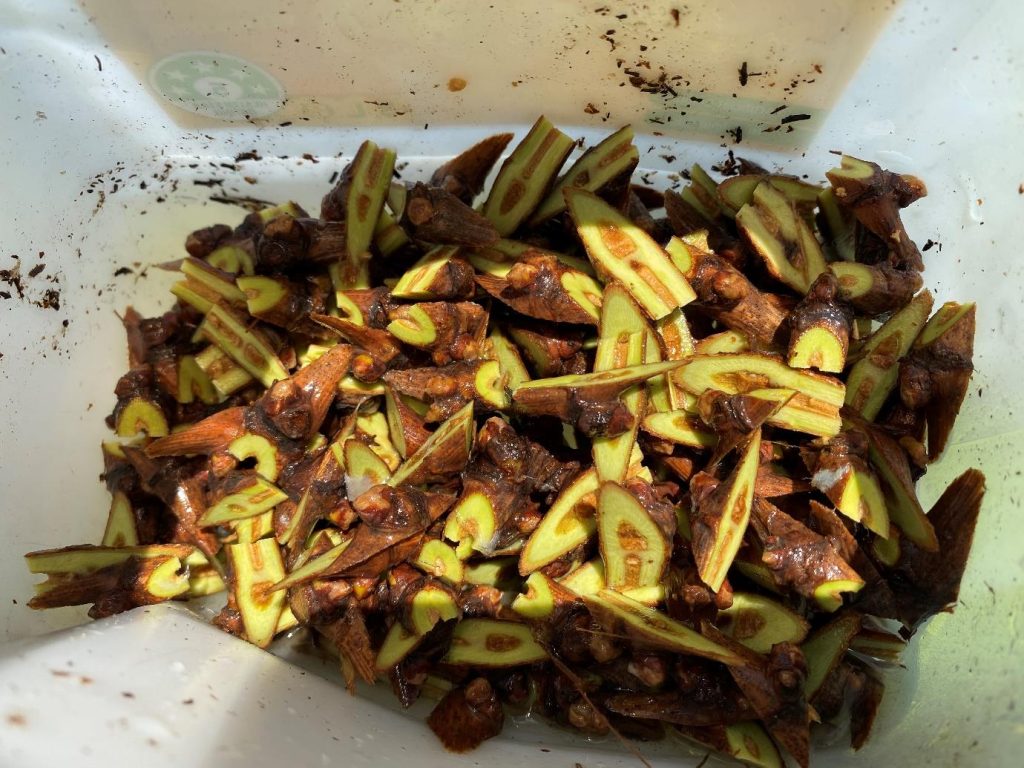
The chip bud method is the most economical method of grafting small of large scale vineyards. It is the fastest form of field grafting which keeps the cost at an affordable level for growers.
Bud cutting
This is done by the grafters who cut buds prior to grafting. Originally the grafting knife was also used to cut buds however there are bud cutting tools available which makes the task faster, safer and more consistent. Buds can last for upto a week or sometime longer however to optimise their viability, a grafter will generally only cut enough a day or two in advance.
Budwood from previous seasons should not be used on a large scale as its viability decreases with age and time spent in a coldroom. The risk of using such material is not worth the return.
Two buds per vine versus one bud per vine
When chip budding, the best approach from our experience is to place two buds into the trunk at the highest point about 15 cm from the top of the trunk. Two buds per vine is the best approcah as it offers a greatly increased chance that at leat one bud will grow and this will then count as a strike. When one bud fails in a single graft, it is then upto regrafting to provide another replacement bud. Depending on when the grafters can return this will result in a time delay of many weeks and even months of lost growing time. The regraft will also have to be placed lower on the trunk which sacrifices some of the trunk height. In many instances, the grafters may not be able to return in that season and as a result the whole seasons growth potential is sacrificed as well as delaying crop, retun on investment and the trunks are more prone to dying back to ground level if the watershoot growth cannot be promoted to keep them alive.
Double buds are the best investment and insurance for field grafting particularly in a constantly unpredicatible seaosnal climate.
Furphy “I only need a single bud vine so I can save money compared with double buds”
False. It is a false economy and the costs of single buds can be very expensive in rectification of a poor strike rate. If a single bud fails then there is no backup and trunks may die back before regrafting can occur. There is lost growing tme until regrafting can occur, a high cost to regraft and potential failure of the regrafted bud.
Placement of buds
In line with cordon wire. Not facing into the midrow. On a straight trunk the grafters will place the buds
On bent trunks on the high side of where the bend begins to allow for a new, straighter trunk to be established and allowing the old one to be removed.
Timing of grafting
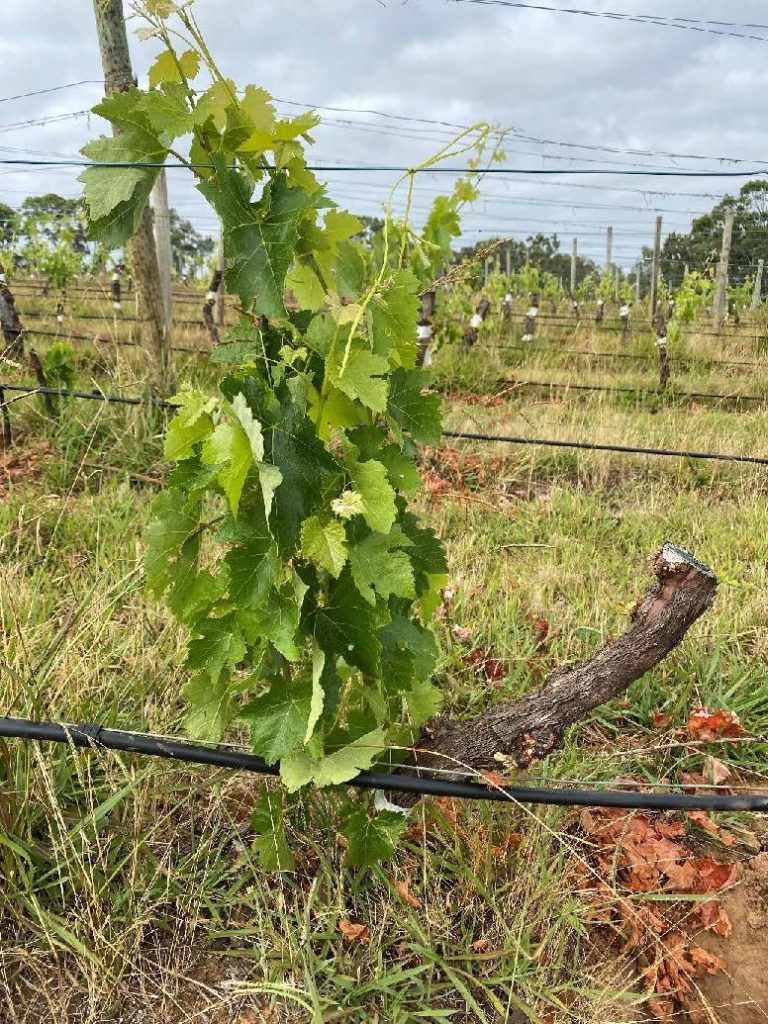
The optimal timing for field grafting using the chip bud method is approximately a 4 month window from September through to January in the Southern Hemisphere. This timing is important for optimal vine growth and callusing as well as climate factors of warm temperatures and high humidity all of which are critical for successful field grafting. If grafting occurs too early or if weather is cold and wet then vines may not have enough sap flow to callus buds and they can dry out and die before weather conditions are condusive to callusing. Too late in the season can leave the new buds exposed to extreme heat and dry soil profiles which can also negatively impact on success of callusing and shoot growth.
Furphy “If my vineyard is grafted as early as possible in the season, my vines will fill the cordon wire faster”
False. Grafting too early in the season can actually jeapordise the growth and strike rate if buds do not callus fast enough. When grafted in the right weather conditions, most grafts will grow quickly to fill the wire within 8 weeks. Grafted shoots grow for longer than established vines so don’t use typical leafall as a guide for cessation of growth.